Alpha Discovery · CSS Selection
#52 How to Select Top Breakout Stocks Using CSS Scores
04/10/2026 · 7 min read
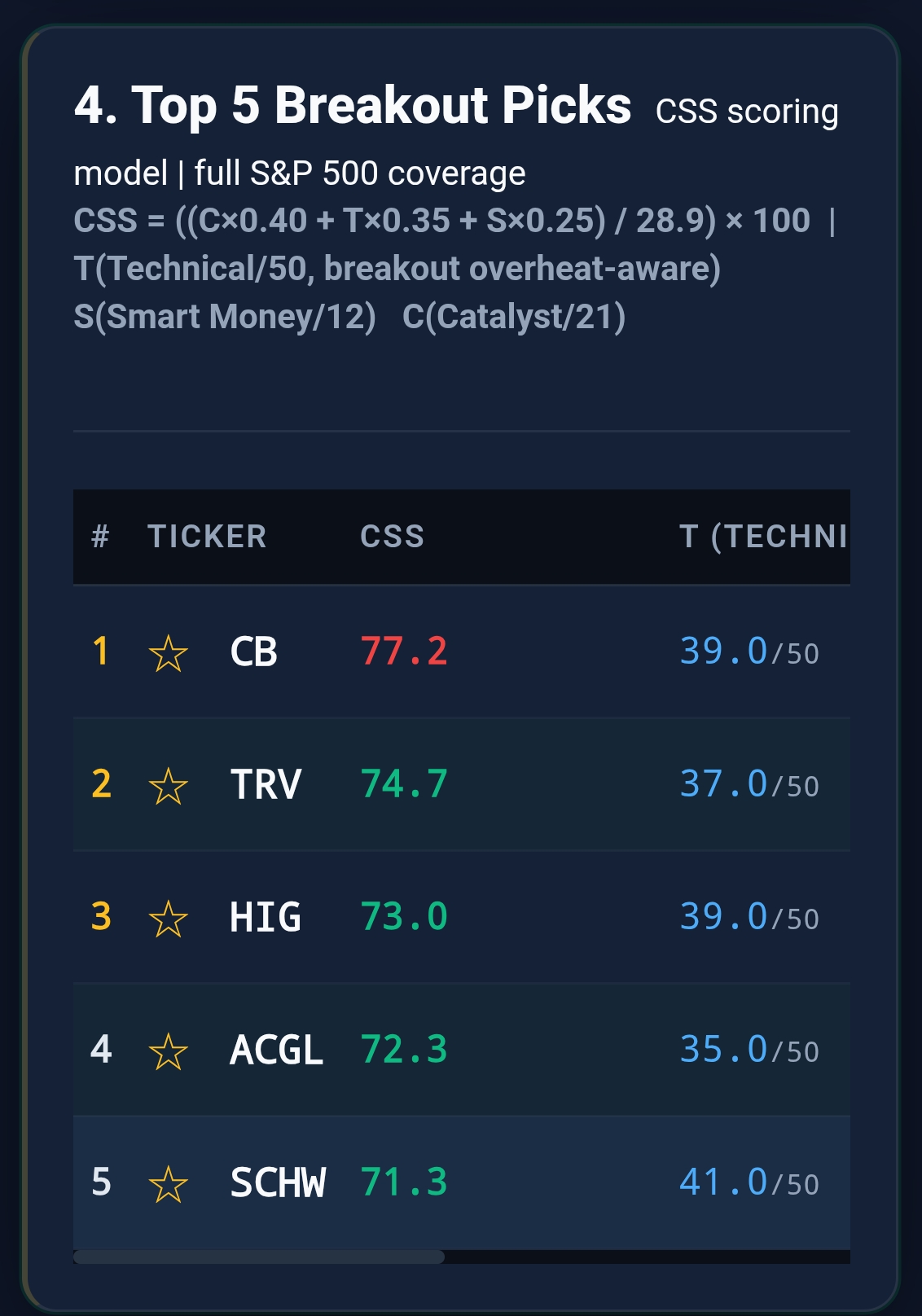
Live capture: Top 5 Breakout Picks and CSS score ranking.
📍 Home › ANALYSIS_1 › Top 5 Breakout Picks
0) Where to Find This Widget
From the 12-tile dashboard, open ANALYSIS_1. The Top 5 Breakout Picks widget (with CSS scores) is on that page.

Live capture of Dashboard in Inveflo.
1) TL;DR
CSS helps rank breakout candidates by catalyst and technical context. It matters because raw breakout lists are noisy and hard to execute. Use this method to turn many names into a clean Top 5 shortlist.
Key Takeaways
- CSS Ranks, Doesn't Trigger: CSS = (40% Catalyst + 35% Technical + 25% Smart Money) / 28.9 × 100. Use ≥70 for top-tier, 55-69 for monitoring, <55 to remove.
- Component Deterioration Matters: High overall CSS with weak catalyst or weak technical = risk signal. Monitor closely; defer entry if components weaken.
- Confirmation Rule: CSS ≥70 + Volume Surge >1.3 + Market Score ≥50 = actionable signal. Skip entries when these conditions aren't met.
- Execution, Not Signal: CSS filters candidates into a clean shortlist; it doesn't execute trades. Pair with position sizing, trend confirmation, and stop placement.
2) Hook (Pain-Driven)
Most breakout lists are too broad to trade. Without a score-driven shortlist, you either overtrade or miss the strongest setups.
3) Problem
A large candidate set creates execution friction. You need a ranking model that emphasizes setup quality, not headline noise.
4) Solution (Widget Introduction)
Use Top 5 Breakout Picks and evaluate CSS with its components: C (Catalyst), T (Technical), and S (Smart Money) to rank candidates.
5) Logic Breakdown (Formula + Thresholds)
- Top-tier candidate: CSS ≥ 70
- Watch candidate: CSS 55-69
- Low-priority candidate: CSS < 55
- Execution confirmation: Volume Surge Ratio > 1.3 and Composite Market Score ≥ 50
6) Practical Use (IF X → THEN Y)
- If CSS ≥ 70 and participation confirms, then include in Top 5 execution set.
- If CSS is strong but catalyst weakens, then keep on watch and defer entry.
- If CSS falls below 55, then remove from active shortlist.
Should I buy now? Buy only when CSS and confirmation align. Is this signal strong? Strong means high CSS plus participation. What should I do next? Promote, monitor, or remove based on CSS band.
7) Common Mistakes
- Treating CSS alone as execution trigger
- Ignoring deterioration in C or S components
- Keeping low-CSS names in active shortlist
This is not a standalone buy signal and requires confirmation and position risk control.
Frequently Asked Questions
What does CSS stand for and how is it calculated?
CSS = Catalyst Surge Score, calculated as ((0.40 × C) + (0.35 × T) + (0.25 × S)) / 28.9 × 100. C = Catalyst (40%), T = Technical (35%), S = Smart Money (25%). Normalized to a 0-100 scale for easy interpretation.
What CSS threshold should I use for my Top 5 shortlist?
Use CSS ≥70 for top-tier candidates to include in active execution. CSS 55-69 candidates are worth monitoring but defer entry. CSS <55 candidates should be removed from active shortlist. Confirm with Volume Surge Ratio >1.3 and Composite Market Score ≥50.
Should I ignore a breakout if it has high CSS but low catalyst?
Yes. If CSS is strong but catalyst component weakens, keep the stock on your watch list but defer entry. Catalyst deterioration signals reduced conviction, and entering without catalyst support increases risk.
Is CSS alone sufficient to make a trade decision?
No. CSS is a ranking tool, not an execution trigger. Use it to filter and prioritize candidates, but confirm with participation (Volume Surge >1.3), market score (≥50), and position sizing rules before entering.
Related Posts
- #7 Breakout Signal Quality Evaluation — Learn to grade signal quality using structure, participation, and catalyst alignment before entry.
- #9 CSS Components Deep Dive Guide — Understand C (Catalyst), T (Technical), and S (Smart Money) components in detail.
- #16 Early Breakout Strategy — Combine CSS selection with early-entry timing rules for optimal execution.
CTA: Check Today's Top 5 Stocks Now
CTA: Open Scanner and Find Opportunities
Scan the full S&P 500, compare quality and signal scores, and build your watch list before market open.