#38 Momentum Trading Strategy: Entry, Chase, and Exit Rules
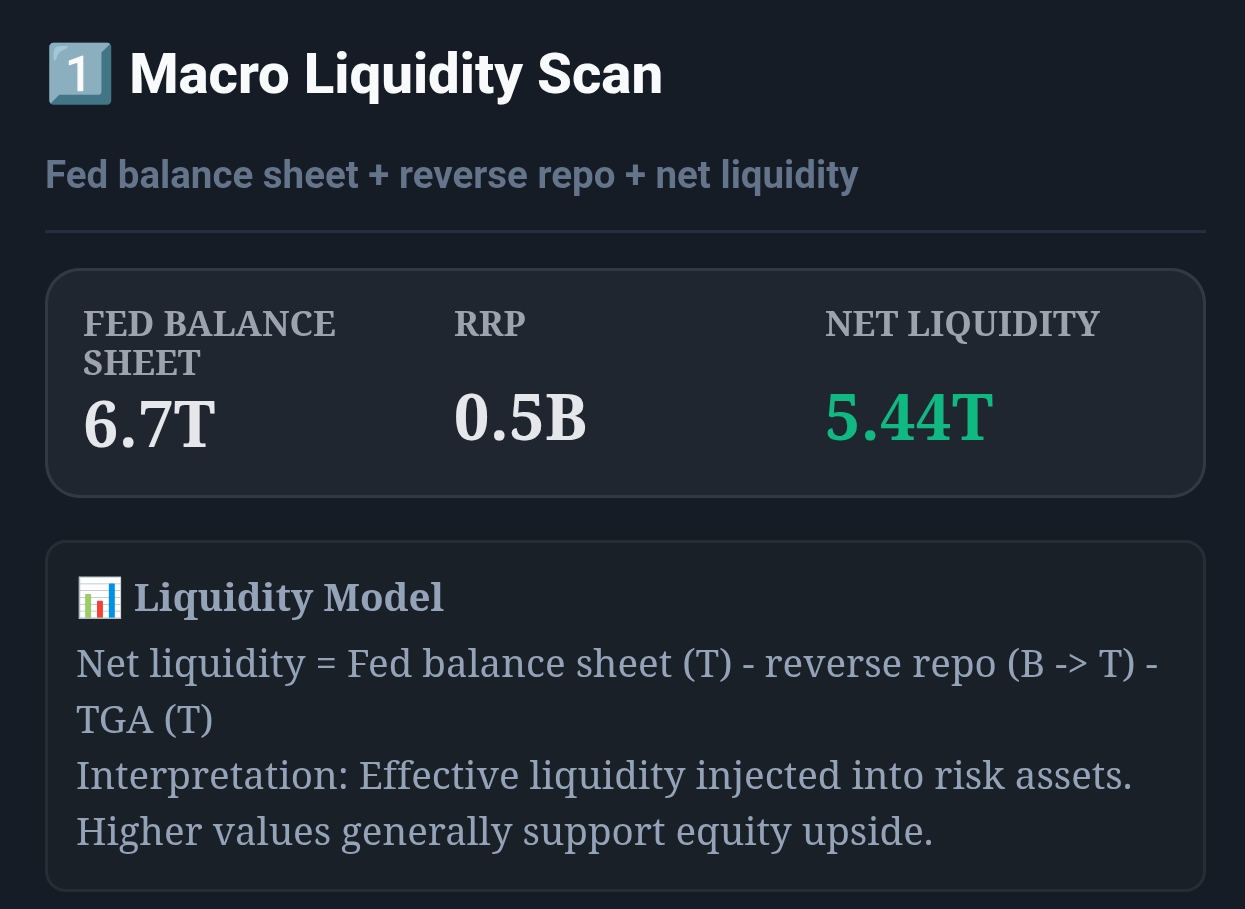
Live capture of Macro Liquidity Scan in Inveflo.
0) Where to Find This Widget

Open the Macro Liquidity Investment System page for Momentum Breakout.
Open /ai-analysis-3.html and use 3️⃣ Momentum Breakout to find candidates, then apply the entry/chase/exit rules below to manage each position.
1) TL;DR
Most traders make the same three momentum mistakes: entering too late (after the bulk of the move), chasing too aggressively (doubling down into extended prices), and exiting too early (selling at the first sign of weakness). The fix is a three-phase rule set: Enter on breakout day with a tight stop, chase by adding only on first pullback (not on extension), and exit via a 15% trailing stop — not emotion.
2) Hook (Pain-Driven)
In 2023 I watched NVDA break out in January with a MomentumScore of 88. I missed the entry. Two weeks later, up 18%, I finally bought — telling myself "the trend is confirmed." NVDA kept going, but I'd entered at the worst risk/reward point. When it pulled back 10%, I panic-sold for a -4% loss. The original breakout would have given me +34% over 3 months. I was right about the stock, wrong about the rules. Entry timing and exit rules are as important as stock selection.
3) Problem
Momentum trading has three distinct failure modes: (1) Late entry at extended prices, creating poor risk/reward. (2) Adding to positions at the wrong time — chasing price instead of waiting for pullbacks. (3) Exiting on minor pullbacks that are normal within strong uptrends, then watching the stock recover and continue 30% higher. Each failure has a specific rule to prevent it.
4) Solution (Widget Introduction)
The three-phase momentum framework:
- Phase 1 — Entry: Enter on breakout day (or within 3 trading days). Initial size: 50–60% of target position. Stop-loss: -5% from entry or below the breakout level (whichever is closer).
- Phase 2 — Chase (Add on Pullback): Wait for first 3–8% pullback after the initial breakout rally. If MomentumScore remains above 65 during pullback, add remaining 40–50% of position. Never add on extension (price moving up, no pullback).
- Phase 3 — Exit (Trailing Stop): Once position is full, set a 15% trailing stop from the highest closing price. Also exit immediately if MomentumScore drops below 50 for 3 consecutive days or if macro regime shifts to Orange/Red.
5) Logic Breakdown (Formula + Thresholds)
Entry Rules: The 3-Day Window
EntryWindow = BreakoutDay + 3 trading days max
- Enter on breakout day (best risk/reward) or within 3 trading days.
- If price has moved more than 8% above the breakout level, the entry window is closed. Do not chase. Wait for the next setup.
- Initial stop: -5% from entry price, OR below the previous support level, whichever is closer.
Chase Rules: The Pullback Add
| Pullback Depth | MomentumScore During Pullback | Action |
|---|---|---|
| 3–8% from peak | > 65 (score holding) | Add remaining position. Healthy pullback in uptrend. |
| 3–8% from peak | 50–65 (score weakening) | Add only 20%. Watch for score recovery before full add. |
| > 10% from peak | Any | Do not add. This is a breakdown, not a pullback. Re-evaluate. |
| No pullback (extension) | Any | Do not chase. Wait. The add will always come on a pullback. |
Exit Rules: Three Triggers
- Trigger 1 — Trailing Stop: Close position if price falls 15% below the highest closing price since entry. Ratchets up automatically as price makes new highs.
- Trigger 2 — Score Decay: If MomentumScore drops below 50 for 3 consecutive trading days, sell 50% immediately and set tighter trailing stop (-8%) on remainder.
- Trigger 3 — Macro Shift: If CombinedRegimeScore (post #21) crosses into Orange or Red, sell the full position regardless of individual stock momentum. Macro regime overrides everything.
6) Practical Use (IF X → THEN Y)
Scenario 1: Stock Breaks Out Day 1 — MomentumScore 82
- Entry: Buy 55% of target size today. Set stop at -5% from today's close.
- Watch for: First 3–8% pullback over next 2–4 weeks. When it comes and score stays above 65, add remaining 45%.
- Exit trigger: Trailing stop at 15% below highest close. Or if score drops to 48 for 3 days → sell 50% immediately.
Scenario 2: Stock Pulls Back 6% on Day 12 — MomentumScore Still 71
- Signal: Healthy pullback. Score holding. This is the chase add opportunity.
- Action: Add remaining 45% of target position. Update trailing stop to 15% below the new high from before the pullback.
Scenario 3: Stock Up 35% — MomentumScore Drops from 79 to 51 over 3 Days
- Signal: Score decay. Momentum fading. Institutional rotation out beginning.
- Action: Sell 50% immediately at market. Tighten trailing stop to 8% on remainder. If score drops below 45 the next day, sell everything.
7) Common Mistakes
Mistake #1: Adding to Positions on Extensions
When a momentum stock is running hard — up 15% in a week — the temptation is to add more. This is backwards. You're adding at the worst risk/reward. Wait for the pullback and add when the stock gives you a better price while the trend remains intact.
Mistake #2: Using a Fixed Stop (e.g., Always -5%)
A fixed -5% stop makes sense at entry. But once the stock is up 30%, a trailing stop at -15% from the high gives the trade room to breathe while protecting your profits. Never use the same stop size at entry as you do when managing a profitable position.
Mistake #3: Holding Through Macro Regime Shifts
Individual stock momentum doesn't protect you from macro-driven drawdowns. In 2022, even the strongest momentum stocks fell 30–50% when macro shifted to Red. When the CombinedRegimeScore flips to Orange/Red, exit momentum positions regardless of how good the individual score looks.
Mistake #4: Re-entering Immediately After Stop-Out
When your trailing stop is hit, wait at least 3–5 trading days before re-evaluating. The same psychological bias that got you into the trade now tells you "it'll bounce back." The stop was hit for a reason — respect it and look for a new, fresh setup.
Q: What if the stock never pulls back 3–8% and keeps going straight up?
Then you stay with the initial 50–60% position and let the trailing stop manage the exit. Not every momentum trade will give you a clean pullback entry for the add. That's fine — the first 50% will still generate strong returns if the trend is real. Accept incomplete position sizing as the cost of missing the pullback window.
Q: Should the trailing stop be based on closing prices or intraday lows?
Closing prices only. Intraday lows can be distorted by stop-hunting, news flashes, and thin market hours. A -15% close-to-close trailing stop gives you a more accurate picture of whether the trend has genuinely broken. A stock can touch -15% intraday and close -8% — the trend is still intact.
Q: How many momentum positions should I hold at once?
3–5 positions is the sweet spot for individual investors. Fewer than 3 creates concentration risk. More than 5 makes it hard to monitor score decay and macro signals closely enough. Each position should be sized so that a full stop-out (entry stop hit) loses no more than 2% of total portfolio value.
Q: What happens to the chase rule if earnings are 2 weeks away?
If earnings are within 2 weeks of your planned chase add, reduce the add size to 20% (instead of 40–50%) and wait for post-earnings confirmation. Earnings can cause a gap-down that triggers your stop immediately after the add, turning a controlled position into a full loss. Smaller pre-earnings adds protect you from this scenario.
CTA: Open Macro Liquidity System
Use the live macro, credit, regime, and momentum widgets to validate the rules from this guide.